

July 15, 2026
What happens after the part leaves the mold?
Why Controlled Robotic Handling Improves Quality, Automation, and Productivity
For many injection molding applications, the job of a robot is often viewed simply as removing the part from the mold. But in today’s highly automated manufacturing environment, the robot plays a much larger role.
As more molders integrate vision inspection, assembly, decoration, leak testing, packaging, and other secondary operations, how a part leaves the mold has become just as important as how it is molded.
Allowing parts to fall freely onto a conveyor or into a collection bin may have been acceptable for simple components, but it introduces unnecessary variability that can affect quality, automation reliability, and overall productivity.
A robot that gently removes, controls, and places each part protects the value created during the molding process while laying the foundation for a truly automated manufacturing cell.
Every Impact Creates Risk
The moment a molded part is allowed to fall, it is subjected to uncontrolled movement and impact. Depending on the application, this can result in:
- Cosmetic scratches or surface blemishes
- Broken gates or delicate features
- Stress whitening
- Deformation while the part is still warm
- Dust or contamination caused by static attraction
- Random orientation on the conveyor
These issues may not be immediately visible but often become the root cause of downstream rejects, customer complaints, or unnecessary handling.
Part Separation Starts at the Mold
One of the most overlooked advantages of robotic part removal is maintaining part separation.
Cavity Sorting Preserves Traceability and Quality Control
In multi-cavity molds, when parts are allowed to fall freely that cavity-level identity is lost the moment they leave the mold. If a defect is later traced back to a specific cavity, manufacturers have no way to isolate which parts came from it without scrapping or re-inspecting the entire lot.
A robot solves this by picking parts directly from each cavity and keeping them segregated by origin. This makes it possible to:
- Route parts to different bins, trays, or fixtures based on cavity number
- Flag or divert output from a suspect cavity without stopping the line
- Maintain full lot traceability back to the exact cavity and cycle
- Support statistical process control (SPC) at the cavity level, not just the shot level
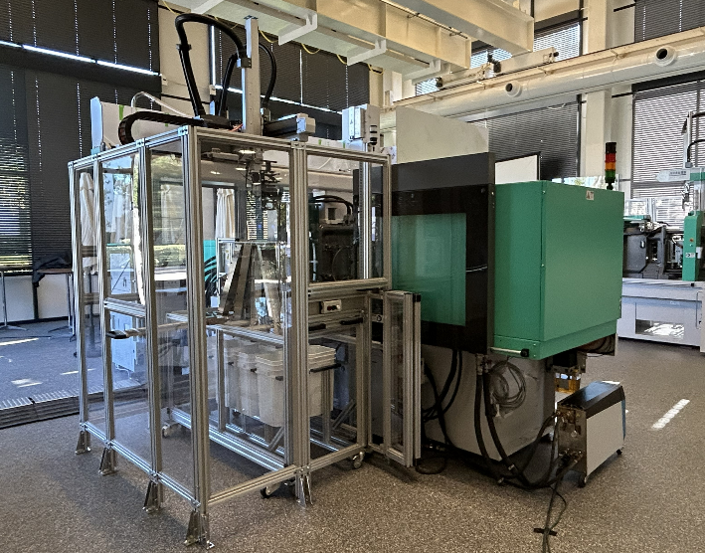
ARBURG’s compact and flexible parts separation – programmable handling integrated into the machine control
Avoiding the Need for Secondary Part Sorting
Because cavity identity and part orientation are preserved from the moment of ejection, there’s no need to reintroduce sorting later in the process. Parts don’t have to be dumped into bulk totes and then re-sorted by vision systems, manual inspection, or mechanical separators downstream.
This eliminates an entire category of secondary equipment and labor, while also reducing the risk of mixing good parts with defective ones. The result is a cleaner, more direct path from mold to packaging – with quality data attached to every part along the way.
Automation Depends on Consistency
Modern manufacturing increasingly relies on automated downstream processes, including:
- Vision inspection
- Laser marking
- Pad printing
- Assembly
- Insert loading
- Leak testing
- Packaging
- Medical device handling
These systems perform best when every part arrives in the same location, in the same orientation, and in the same condition.
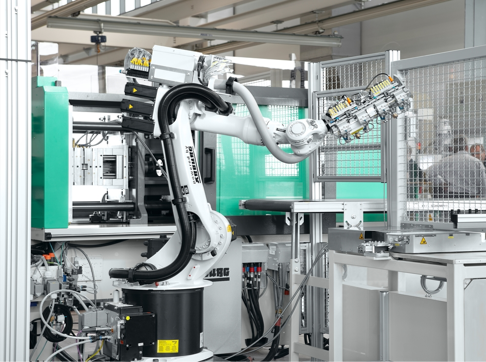
By placing each component with repeatable precision, robotic handling eliminates much of the variability that can lead to jams, misfeeds, and production interruptions. Instead of designing equipment to recover from randomly dropped parts, manufacturers can build simpler, more reliable automation cells.
Protecting Quality Throughout the Process
Today’s molded parts are often precision-engineered products destined for demanding industries such as medical, electronics, automotive, and consumer packaging.
For these applications, even minor cosmetic damage or dimensional distortion can result in scrap or costly rework.
Controlled robotic handling helps preserve the part quality and the same condition in which it was molded.
Building the Foundation for Lights-Out Manufacturing
As manufacturers pursue higher levels of automation, consistency becomes increasingly important.
Robotic extraction provides:
- Controlled part handling
- Individual part separation
- Repeatable placement
- Consistent orientation
- Reduced operator intervention
- Reliable transfer between manufacturing processes
The result is a stable production flow that supports unattended operation while reducing downtime and improving Overall Equipment Effectiveness (OEE).
More Than Just Removing a Part
Robots are often justified based on labor savings or reduced cycle time. While these are valuable benefits, they represent only part of the return on investment.
The greater value lies in protecting each molded part from the instant it leaves the mold. By eliminating uncontrolled drops, maintaining part separation, and delivering every component in a consistent orientation, manufacturers improve product quality, simplify downstream automation, reduce equipment complexity, and create more predictable production.
The molded part is only the beginning of the manufacturing journey.
The most successful automation strategies focus on protecting the part from the moment it leaves the mold through every downstream process.
Reach out to Turner Group to learn how integrated robotic handling solutions can help build a more reliable, efficient, and automated production environment.
For more information, explore the articles below:
Solution by Sepro: automation solutions | Sepro Group
Turnkey solutions for different areas of application | ARBURG