

The Importance of Optimum Clamp Force in Injection Molding
More Clamp Force Isn’t Always Better
In injection molding, clamp force plays a critical role in maintaining mold integrity, part quality, and process consistency. Its primary purpose is to keep the mold securely closed against the separating forces generated by cavity pressure during injection and packing.
However, a common misconception is that applying more clamp force than necessary provides additional process security.
The objective should be to use the lowest clamp force that reliably prevents mold separation and flash while maintaining consistent part quality.
1. How Much Clamp Force Does a Machine Really Need?
The answer is straightforward: Enough clamp force to keep the mold securely closed across its parting surfaces and all cavities throughout injection and packing.
The required force depends primarily on the projected area of the molded parts and runner system, cavity pressure, and the number of cavities.
However, the total clamp force is only part of the equation. How evenly that force is distributed across the mold is equally important.
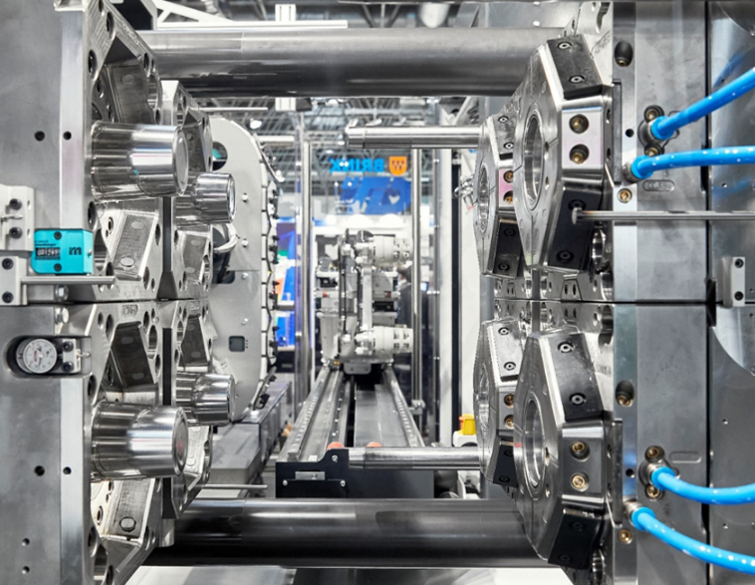
This is why platen and mold parallelism are critical. Poor parallelism can result in uneven contact pressure, localized mold separation, flash, and excessive wear, even when the machine has sufficient nominal clamp tonnage.
Proper machine alignment, mold construction, and uniform force distribution are essential for reliable production.
2. The Hidden Cost of Excessive Clamp Force
Using more clamp force than necessary may appear harmless, but excessive force can introduce several disadvantages:
- Mold wear: Unnecessary loading of parting surfaces, mold components, and alignment features.
- Machine stress: Increased mechanical loading of platens, tie bars, and clamping components.
- Energy consumption: Depending on the clamping system, excessive force may increase energy requirements.
- Process visibility: Excessive clamp force can mask underlying issues such as inappropriate cavity pressure or poor mold venting.
Over time, these factors may contribute to increased maintenance costs and reduced equipment life.
3. Finding the Optimum Clamp Force
Establishing the appropriate clamp force requires a controlled, systematic approach.
One commonly used method is to begin with a proven, stable molding process and gradually reduce clamp force while monitoring part quality and mold behavior.
The objective is to identify the point at which mold separation, flash, or dimensional changes begin to occur, then establish an appropriate operating margin above that threshold.
Parting-line behavior, tie-bar loading, cavity pressure, and part dimensions can provide valuable information during this evaluation.
Any optimization should remain within the machine and mold manufacturer’s operating limits.
4. Clamp Force and Process Consistency
Clamp force should not be considered independently of the molding process.
Changes in melt temperature, injection speed, packing pressure, material viscosity, or cavity balance can influence the forces acting to separate the mold.
A clamp force setting that performs adequately under one set of conditions may not provide sufficient protection when processing conditions change.
Maintaining a stable process and understanding these interactions are essential for achieving consistent production.
5. The Role of Modern Machine Technology
Modern injection molding machines provide increasingly sophisticated methods of controlling and monitoring the clamping process.
ARBURG, for example, offers precise clamping control and machine monitoring capabilities that help processors establish repeatable operating conditions.
Advanced technologies, such as ARBURG’s automatic clamping force regulation option, can automatically determine and adjust the required clamp force based on mold behavior, helping minimize unnecessary mechanical stress, reduce mold wear, and maintain consistent part quality.
Combined with proper platen parallelism and uniform force distribution, these technologies help processors achieve more reliable and efficient molding conditions.
Conclusion: Optimum Is Better Than Maximum
Clamp force is not simply a machine setting to be maximized. It is an important processing parameter that influences part quality, mold protection, machine loading, and potentially energy efficiency.
Too little clamp force risks flash and mold separation. Too much can introduce unnecessary mechanical stress without improving part quality.
The goal is not to use all the clamp force available, but to apply the right amount of force, distributed uniformly across the mold, with an appropriate operating margin.
How Turner Group Can Help
Turner Group works with injection molders to evaluate machine selection, processing performance, and opportunities to improve manufacturing efficiency.
Contact Turner Group to discuss how optimizing clamp force can improve process consistency, protect tooling, and support long-term productivity.