
October 21, 2026
Not Every Automation Application Needs the Same Robot
Automation in plastics processing has moved well beyond simply removing a part from a machine. Robots can now handle parts, place inserts, interact with inspection systems, perform secondary operations, support assembly and packaging, and connect multiple processes within an automated cell.
But not every application needs the same type of robot.
Sprue Pickers – Keep It Simple
For straightforward applications, a sprue picker may be all that’s required. Typically used to remove runners or sprues, these relatively simple devices can provide an economical solution where complex positioning or part manipulation isn’t necessary.
Cartesian Robots – The Injection Molding Workhorse
Three-axis Cartesian, or linear, robots are widely used in injection molding. Their movements are well suited to entering the mold area, removing the part and transferring it outside the machine.
They offer speed and repeatability for part removal, placement, stacking and sorting, while their overhead configuration can help preserve valuable floor space.
5-Axis – Adding Flexibility
Adding servo wrist axes allows a Cartesian robot to do more than simply move a part from point A to point B.
The additional movement can orient and manipulate parts for insert placement, inspection, assembly or interaction with secondary equipment. This provides a useful middle ground between conventional Cartesian and fully articulated automation.
6-Axis – Greater Freedom of Movement
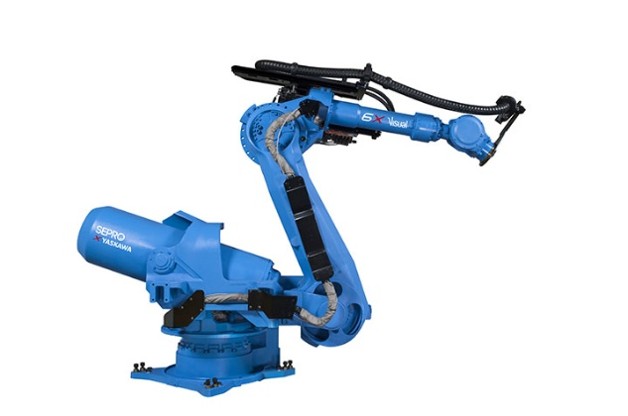
Articulated 6-axis robots can approach parts and equipment from multiple directions, making them well suited to more complex applications.
They can be particularly valuable for assembly, inspection, machine tending and automation cells where the robot performs several operations during the production cycle.
Cobots – Another Automation Option
Collaborative robots, or cobots, can be useful for secondary operations, inspection, assembly and packaging, particularly where people and automation need to work in closer proximity.
However, collaborative doesn’t automatically mean no guarding. Speed, payload, tooling and the complete application still need to be appropriately risk assessed.
Integration Matters Too
Robot type is only part of the decision. Processors should also consider how closely the automation needs to integrate with the molding machine and surrounding equipment.
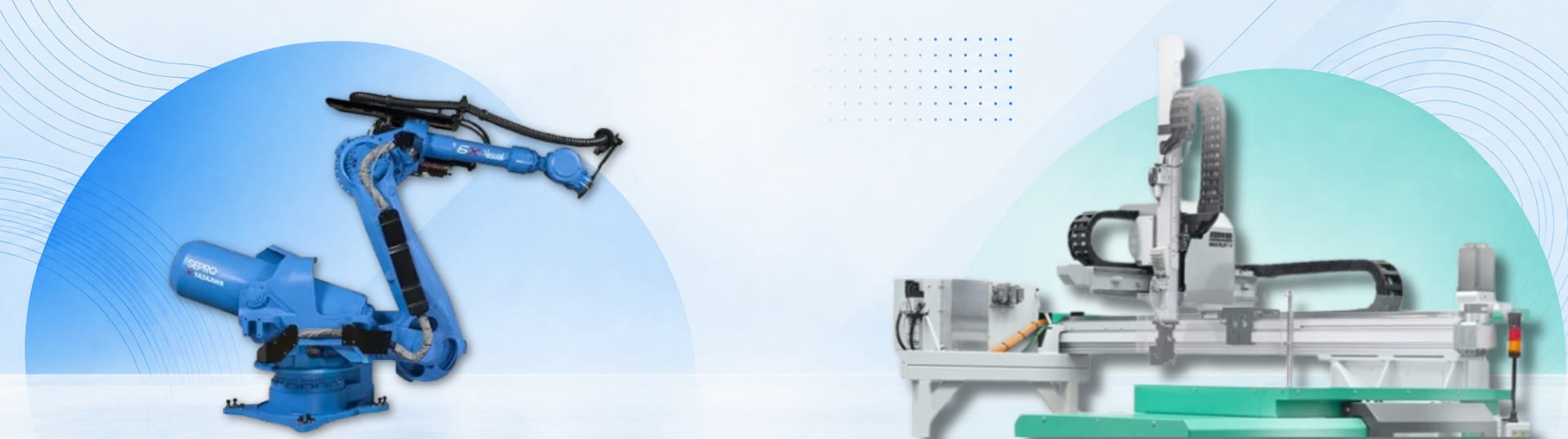
Manufacturers such as ARBURG and Sepro offer examples of the range of automation approaches available, from highly integrated linear robots to more flexible multi-axis solutions.
But the decision shouldn’t start with a brand – or even the number of axes.
It should start with one question:
What does the application need the robot to do?
Part weight, cycle time, reach, payload, orientation, floor space and downstream operations should all influence the answer.
And perhaps the most important question isn’t simply:
“How do we get the part out of the mold?” It’s: “What needs to happen to the part next?”
Does it need to be inspected, oriented, assembled, separated, conveyed or packaged?
Thinking beyond part removal can transform automation from a simple take-out device into an integral part of the production process.
The right robot isn’t necessarily the most sophisticated robot. It’s the robot that best fits the process.
Not sure which automation approach fits your application?
Talk with Turner Group about what happens from the moment the mold opens through the next production step. By understanding the complete process, we can help identify an automation approach that fits the application – without overcomplicating it.