

The Brain Behind the Press: Why Machine Controls Now Define Competitive Advantage
For decades, injection molding machines were evaluated by tonnage, shot size, and hydraulic power. Controls were necessary – but secondary.
That is no longer true.
Today, the control system is the machine. It determines repeatability, documentation capability, integration potential, and ultimately profitability. In modern plastics manufacturing, the competitive edge lives in the architecture of the control platform.
From Manual Adjustments to Digital Precision
Early injection molding machines relied on mechanical and analog systems. Operators adjusted pressures and speeds manually, responding to variation after it occurred. Process stability depended heavily on experience and tribal knowledge.
The introduction of PLC-based systems and closed-loop control changed the game. Digital monitoring improved repeatability. Servo drives improved efficiency. Graphical interfaces improved usability.
But even then, controls were still primarily machine-focused – built to run the press, not manage production.
The Shift: From Machine Control to Process Intelligence
Modern manufacturing demands more than consistent cycles. It requires:
- Real-time process transparency
- Validated documentation for regulated markets
- Seamless automation integration
- Energy monitoring and sustainability tracking
- Predictive maintenance insight
This is where ARBURG has consistently stayed ahead.
Its GESTICA control platform was engineered not simply as an interface, but as an intelligent production system. With high-resolution visualization, intuitive navigation, and integrated assistance functions, the control moves beyond parameter entry and becomes a decision-support tool for operators and engineers alike.
Instead of reacting to deviation, processors can now monitor trends, stabilize processes proactively, and document production with clarity.
The difference is architectural. Many controls in the market evolved incrementally from legacy systems. ARBURG’s platform reflects a forward-looking digital design philosophy – built for connectivity and long-term scalability.
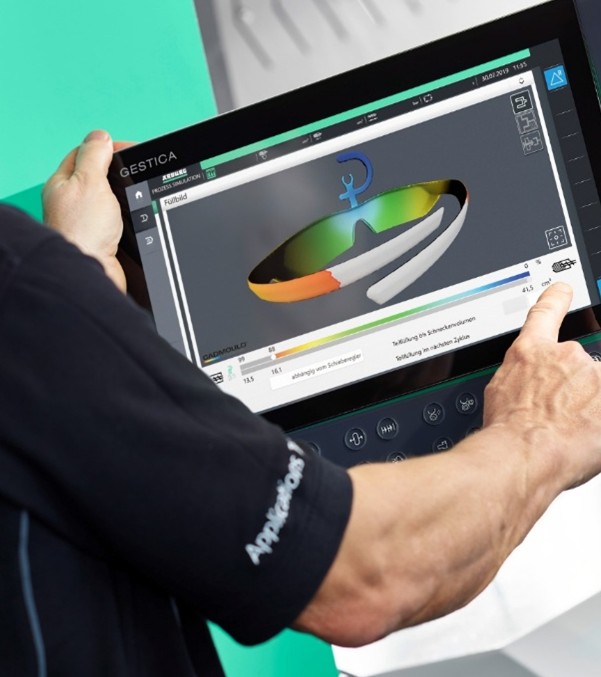
GESTICA: Simulation of the mold filling and calculation of setting parameters online in the control system.
AI at the Control Level: The Next Evolution
Artificial intelligence is now moving from concept to practical application inside modern control systems.
Rather than replacing operator expertise, AI-enhanced controls analyze historical cycle data, identify subtle deviations, and support predictive decision-making. Pattern recognition allows the system to flag process drift before defects occur. Assistance systems can suggest optimized parameters based on validated production history.
ARBURG has begun integrating AI-supported tools – including digital advisory features and intelligent assistance functions – that enhance process stability and user guidance. The goal is not automation for its own sake, but smarter process oversight that reduces variability, shortens start-up times, and improves consistency across shifts.
As workforce experience levels fluctuate, this layer of embedded intelligence becomes increasingly valuable.
Connectivity as a Foundation, Not an Add-On
In medical, technical, and high-precision molding environments, traceability and integration are not optional. They are required.
Native OPC UA communication, structured data output, and seamless automation interfaces allow machines to operate within a connected manufacturing ecosystem.
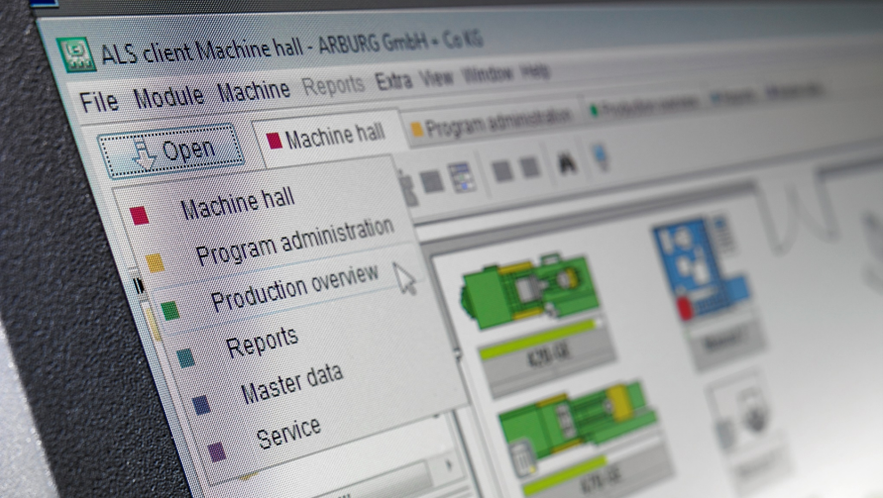
Beyond the press itself, ARBURG extends intelligence to the production level through its ALS (ARBURG Leitstand System). ALS connects machines across the floor, enabling centralized job management, live production monitoring, documentation, and performance transparency. Instead of isolated presses, manufacturers gain coordinated production visibility.
That shift – from machine control to production orchestration – is where long-term competitive advantage is created.
Intelligence at the Edge of the Process
Modern control systems increasingly support operators with structured workflows, process assistance, and built-in validation logic. This reduces dependency on individual experience and improves repeatability across shifts.
For companies facing tighter process windows, workforce transitions, and growing regulatory demands, this matters. Controls are no longer just tools for experts. They are platforms that elevate the entire production team.
ARBURG’s development philosophy reflects this reality — integrating control intelligence with mechanical precision, automation compatibility, and digital readiness.
Why Controls Now Drive ROI
When evaluating capital equipment today, the question is no longer only: How fast does it cycle?
The more strategic questions are:
- How transparent is the process data?
- How easily can this integrate with automation and MES systems?
- How scalable is the control architecture five or ten years from now?
- How well does it support validated manufacturing environments?
The answers directly influence scrap rate, uptime, labor efficiency, audit readiness, and long-term flexibility.
In other words, the control platform increasingly determines the return on investment.
The Competitive Reality
Injection molding machines may still be described by clamp force and tie-bar spacing.
But the companies shaping the future of plastics manufacturing understand something deeper:
The true differentiator is not the steel. It is the intelligence behind it.
Machine controls have evolved from adjustment panels to digital infrastructure. They now connect processes, document performance, guide operators, incorporate AI-supported insights, and coordinate production environments.
Manufacturers investing in intelligent control architecture are not just purchasing equipment — they are building the foundation for connected, scalable, and future-ready production.
And in that evolution, ARBURG continues to operate at the forefront.